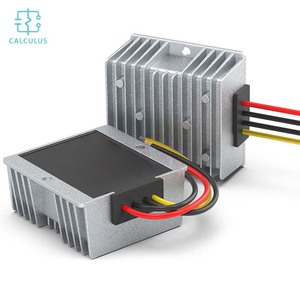
DC DC Converter 24V to 12V 10-30A Step Down Buck Converter Car Truck Voltage Regulator
- Output Current: 10A - 30A Continuous
- Conversion Efficiency: >95%
- Certifications: CE, RoHS, ISO9001
- Enclosure: Die-Cast Aluminum IP68
 Power Conversion Engineering
Explore our flagship portfolio of step-down voltage regulators engineered with synchronous rectification, wide input range tolerance, ultra-high efficiency, and robust industrial protection.
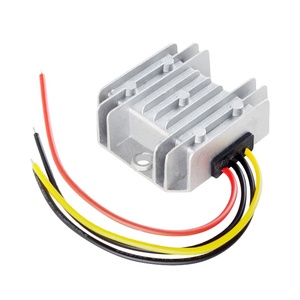
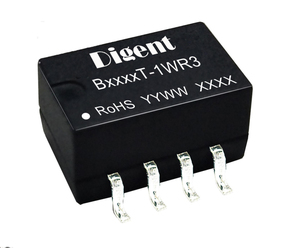
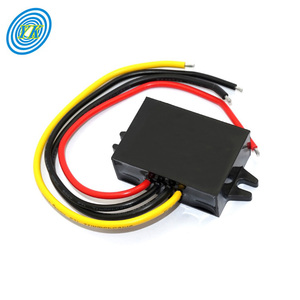
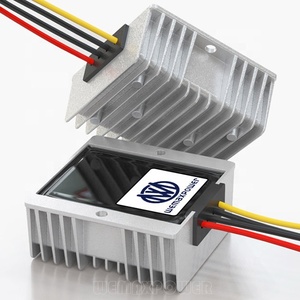
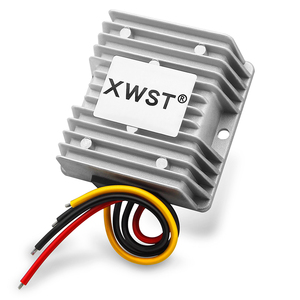
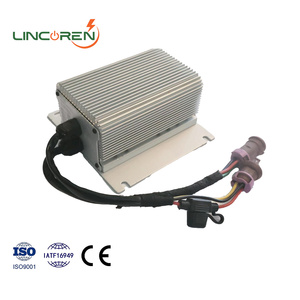
In the contemporary power electronics landscape, the requirement for high-density, thermally optimized, and regulatory-compliant direct current (DC) step-down conversion has reached an unprecedented scale. As global industries shift toward electrified transportation, automated industrial process cabinets, renewable energy harvesting, and distributed DC microgrid architectures, selecting a dependable CE certified buck converter exporter is a critical engineering decision. Direct-current step-down regulators (commonly designated as buck converters) serve as the fundamental backbone for converting elevated DC bus voltages—such as 72V, 48V, or 24V vehicle battery systems—into stabilized, regulated lower output rails including 14V, 12V, 9V, or 5V DC for sensitive electronic payloads, microcontrollers, communication sensors, and auxiliary lighting arrays.
Achieving international export readiness requires far more than basic voltage transformation. Compliance with the European Union’s CE mark necessitates strict alignment with the Low Voltage Directive (LVD 2014/35/EU) and the Electromagnetic Compatibility Directive (EMC 2014/30/EU), alongside environmental standards such as RoHS 3 (2015/863/EU) and REACH. A premier buck converter exporter must demonstrate robust electrical engineering design principles, utilizing advanced topologies like synchronous rectification, planar magnetics, transient voltage suppression (TVS), and IP68-rated protective encapsulation. This technical whitepaper explores the critical architectural parameters, global compliance frameworks, procurement trends, and custom engineering capabilities defining modern power conversion exports.
Technical Insight: Synchronous buck converters replace the traditional Schottky free-wheeling diode with a low-resistance N-channel MOSFET (Rds(on) < 5mΩ). This architectural modification drastically reduces conduction losses ($P_{loss} = I^2 \times R_{ds(on)}$ vs $P_{loss} = I \times V_f$), driving total power conversion efficiency beyond 96% while reducing heat generation by up to 60%.
Step-down buck converters operate by switching energy storage elements—primarily high-frequency inductors and ceramic/solid-electrolytic capacitor banks—at switching frequencies typically ranging from 100 kHz up to 2.2 MHz. The core pulse-width modulation (PWM) IC regulates the duty cycle ($D = V_{out} / V_{in}$), continuously compensating for dynamically fluctuating input voltages and sudden step-load variations. Below is a detailed feature overview detailing our engineering approach for export-grade power modules:
Utilizes active power MOSFET switches synchronized with the main control IC to eliminate forward diode voltage drop, delivering peak thermal performance under heavy continuous current loads.
Potted with thermally conductive epoxy compound (thermal conductivity > 1.5 W/m-K) inside anodized aluminum enclosures to guarantee complete moisture, vibration, and dust immunity.
Integrated multi-stage LC input filtering combined with shielded inductors ensures compliance with CISPR 32 / EN 55032 Class B radiated and conducted emission limits without requiring external filters.
When selecting a CE certified step-down regulator for international procurement, system engineers must evaluate mechanical design, thermal resistance, input range tolerance, and efficiency profile. The matrix below contrasts standardized buck converter product categories manufactured for global export:
| Converter Category | Nominal Input Range | Output Voltage / Current | Peak Efficiency | Thermal Dissipation & Cooling | Target Applications |
|---|---|---|---|---|---|
| Compact Board-Mount (PCB) | 9V - 36V DC (4:1) | 3.3V, 5V, 9V @ 1A - 3A | 91% - 93% | Natural Convection / Copper Planes | FPGA, IoT Gateways, Embedded Telemetry |
| Automotive Heavy-Duty Buck | 18V - 36V DC (24V Bus) | 12V DC @ 10A - 30A | 95% - 97% | Aluminum Chassis Baseplate Conduction | Truck Auxiliary Power, Construction Equipment |
| High-Voltage EV Subsystem | 36V - 72V DC (EV Range) | 12V / 13.8V @ 20A - 50A | 94% - 96.5% | Heavy Aluminum Extrusion Fin Cooling | Electric Buses, Golf Carts, AGV Logistics |
| Wide-Input Universal Regulator | 9V - 60V Ultra-Wide | 12V DC @ 3A - 5A | 92% - 95% | Solid Silicone Potting (IP68 Encapsulated) | Solar PV Battery Banks, Marine Craft |
As international supply chains evolve, global procurement officers and system integrators are navigating shifting technological requirements. Sourcing managers are moving away from commodity voltage transformers toward highly integrated, intelligent power conversion platforms. Understanding these macroeconomic and technical trends allows procurement teams to future-proof their supply chain and secure long-term component availability.
Across automotive, data center, and industrial automation sectors, the global market is rapidly transitioning from traditional 12V power distribution networks to 48V DC buses. Raising the distribution voltage by a factor of four decreases operating current by 75% for identical power delivery. According to Joule's first law ($P = I^2 R$), this yields a 16-fold reduction in cable copper resistive losses. Consequently, the international demand for CE-certified 48V to 12V buck converters is experiencing exponential growth.
Furthermore, the commercial introduction of Gallium Nitride (GaN) and Silicon Carbide (SiC) field-effect transistors is revolutionizing step-down converter power density. GaN switches exhibit ultra-low gate charge ($Q_g$) and zero reverse recovery time ($Q_{rr}$), allowing switching frequencies to increase from hundreds of kilohertz to multiple megahertz. This dramatically shrinks the physical footprint of magnetic inductors and smoothing capacitors while elevating power density beyond 100 Watts per cubic inch.
Exporting buck converters into the European Economic Area (EEA) and global markets governed by IEC standards demands rigorous testing. Uncertified or poorly filtered buck converters act as primary sources of high-frequency electromagnetic interference (EMI), creating harmonic noise that disrupts nearby wireless communications, CAN bus telemetry, and sensitive measurement sensors.
Ensures conducted emissions on DC power lines and radiated electromagnetic fields stay well below regulatory thresholds across the 150 kHz to 6 GHz spectrum.
Incorporates hazard-based safety engineering principles, assessing thermal burn hazards, dielectric withstand capability, overcurrent protection, and mechanical enclosure integrity.
Guarantees total restriction of hazardous substances including Lead (Pb), Cadmium (Cd), Hexavalent Chromium, and PBB/PBDE flame retardants across all sub-components.
Leading global buyers increasingly leverage modified-standard engineering models. Rather than undertaking expensive, full-custom power supply design from scratch—which requires multi-year development cycles and costly safety re-certifications—OEMs utilize established, CE-approved catalog platforms modified for specific wire harnesses, custom connectors, tailored voltage trim settings (-10% to +15%), or specialized mounting brackets. This hybrid sourcing strategy reduces qualification lead times from months to weeks.
Combining over six decades of power conversion engineering expertise (tracing back to Wall Industries' 1961 foundation) with state-of-the-art automated manufacturing and stringent quality verification.
Our manufacturing facilities operate under strict ISO 9001 certified quality control systems. Every buck converter unit undergoes 100% full-load thermal burn-in testing, automatic optical inspection (AOI), and multi-parameter electrical validation prior to export packaging.
Equipped with calibrated spectrum analyzers, LISNs (Line Impedance Stabilization Networks), and surge/transient generators. We verify radiated and conducted EMI profiles early in the design cycle, eliminating certification delays for global OEM clients.
As an established international exporter, we supply comprehensive regulatory documentation packages—including CE Declarations of Conformity (DoC), RoHS compliance certificates, detailed datasheets, and HS code classification (8504.40)—to simplify customs clearance worldwide.
From custom output voltages (e.g., 24V to 13.8V high-current chargers) to custom potted IP68 enclosures capable of enduring harsh automotive vibration (MIL-STD-810G), our electrical engineering team turns complex power challenges into production-ready products.
Expert insights compiled by our senior applications engineering team to assist global purchasing managers and power electronics designers.
A non-isolated buck converter shares a common ground electrical path between the input power source and the output load, maximizing power density and efficiency (often >95%) at lower unit costs. An isolated converter utilizes an internal high-frequency transformer to separate the primary and secondary grounds, providing safety isolation (e.g., 1.5kV to 3kV DC) and eliminating ground loop interference. Non-isolated buck converters are ideal when ground separation is not required by safety regulations.
Our heavy-duty automotive and truck buck converters incorporate multi-stage transient protection networks. This includes high-energy Metal Oxide Varistors (MOVs), heavy-duty TVS diodes, and input LC filtering capable of absorbing inductive load dump surges up to 100V, guaranteeing uninterrupted operation and preventing downstream damage to sensitive electronics.
Every export shipment is backed by a formal CE Declaration of Conformity (DoC) signed by our engineering director, detailing compliance with EN 62368-1 safety standards and EN 55032 Class B EMC standards. Full lab test reports, RoHS 3 material declarations, and MTBF reliability calculation reports (MIL-HDBK-217F standard) are available upon request.
Standard catalog buck converter models are maintained in stock for immediate sample dispatch. For modified-standard configurations (such as specialized wire lengths, waterproof connectors, or custom pinouts), our typical MOQ starts at 100 units, with prototype samples delivered within 2 to 3 weeks and full production releases completed in 4 to 6 weeks.
Full encapsulated potting with thermally conductive epoxy compound eliminates internal air pockets around high-temperature components (switching MOSFETs, inductors, and control ICs). Heat is uniformly conducted away from internal hot spots out to the outer aluminum chassis. Additionally, solid potting provides IP68 dust/moisture sealing and exceptional shock resistance in rugged environments.
Yes. Our industrial-grade buck converters are designed with premium high-temperature components (105°C long-life solid capacitors and automotive-grade MOSFETs). They operate across an ambient temperature range of -40°C to +85°C. Derating curves are published in each technical datasheet to assist engineers in designing appropriate thermal systems.