Power Conversion Engineering
Talk to an engineer (888) 597-9255
Products Power Conversion Engineering China has a broad industrial power-supply market, but finding the right supplier takes more than comparing prices. Buyers should examine product specifications, manufacturing capability, and the evidence behind quality claims. This guide explores how to assess China-based suppliers of Open Frame Industrial Power Supplies, from established manufacturers to specialized exporters.
Start with the details that affect real installations. Check the input range, output voltage, rated power, operating temperature, and cooling requirements. An open-frame unit may sit inside a control cabinet, where airflow, mounting holes, and nearby heat sources matter. Ask for test reports and product documentation, and confirm that any stated certifications apply to the exact model. Good questions reveal useful details.
Supplier checks matter just as much. Consider production capacity, sample availability, customization options, lead times, and after-sales support. A responsive contact is helpful, but written answers and consistent technical documents are more useful. A catalog photo is not proof. Request a sample when practical, then compare its dimensions, connectors, and performance with your application requirements.
There is no perfect ranking for every buyer. Published information can be incomplete, and a low quoted price may exclude testing, packaging, or shipping costs. This overview will help readers build a shortlist and compare suppliers on practical criteria rather than slogans. Treat each claim as something to verify. Even a careful comparison has limits; confirm critical specifications directly with the supplier before making a purchasing decision.
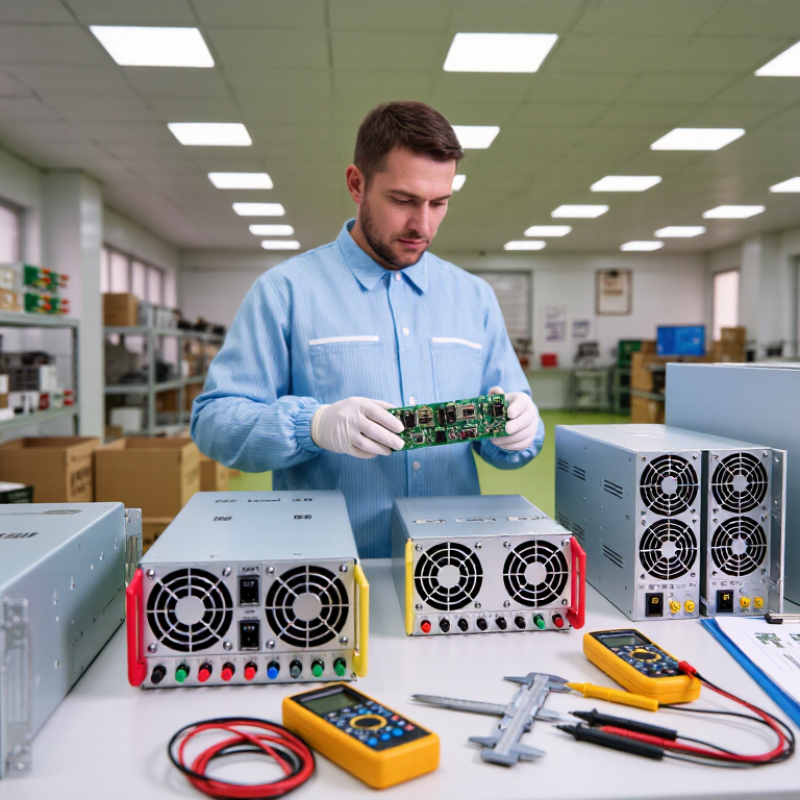
Open-frame industrial power supplies convert incoming AC mains into regulated DC for electronic equipment. Their circuit boards and components sit on a metal chassis, without a fully enclosed outer case. This construction can save space and support cooling inside a machine cabinet. It also leaves terminals and components exposed, so the finished equipment must provide suitable protection.
Typical AC–DC applications include programmable logic controllers, factory sensors, machine-vision systems, instrumentation, and communications equipment. A unit may deliver 24 V DC to a control rail, where wiring runs to sensors and relay modules. Engineers check input-voltage range, output stability, ripple, temperature limits, and overload response. Clearance and airflow matter too. Real cabinets are often crowded, not ideal test benches.
Energy efficiency is increasingly relevant as electronic loads grow. The International Energy Agency’s Electricity 2024 report estimates data centres used about 460 TWh worldwide in 2022, with demand potentially exceeding 1,000 TWh by 2026. That is not an industrial power-supply market estimate, but it highlights the broader cost of powering electronic equipment. Small conversion losses add heat. Designers should compare performance under realistic loads, not only headline efficiency figures; that detail is easy to overlook.
| Supply Type | Typical Technical Characteristics | Common AC–DC Applications | Key Selection Checks |
|---|---|---|---|
| What “open-frame” means | A power-conversion assembly without a fully enclosed outer case. Components are mounted on a circuit board or metal chassis, often with a protective cover available as an option. | Equipment in which the power supply is installed inside a larger, ventilated enclosure, such as control cabinets, test instruments, and medical or factory equipment. | Confirm that the host equipment provides adequate protection from accidental contact, dust, moisture, and conductive debris. |
| Low-power AC–DC | Typically about 5–50 W; commonly used for low-voltage DC rails. Output voltage, input range, efficiency, and dimensions vary by model. | Control boards, sensors, small automation devices, communications equipment, and embedded systems. | Check standby consumption, output ripple and noise, load regulation, inrush current, and the required mounting arrangement. |
| Medium-power AC–DC | Typically about 50–300 W; may use convection cooling, forced-air cooling, or a combination depending on load and installation conditions. | Industrial controllers, HMI terminals, machine vision equipment, laboratory instruments, and equipment control panels. | Verify the continuous output rating at the actual ambient temperature and airflow. Review derating curves and thermal protection behavior. |
| Higher-power AC–DC | Typically about 300 W and above; many designs require forced-air cooling or heat transfer to the host chassis. Output current and power density are model-specific. | Industrial computing, automation systems, motion-control equipment, and larger electronic assemblies. | Assess cooling, peak-load capability, output connector or terminal ratings, hold-up time, and the effect of nearby heat sources. |
| AC input and DC output | Many models accept a wide-range AC input, often around 85–264 V AC, and provide regulated DC outputs such as 5 V, 12 V, 24 V, or 48 V. Exact ratings vary by product. | Converts utility AC into the low-voltage DC power used by electronic circuits, sensors, controllers, and actuators. | Match the input range to the installation’s supply voltage and frequency. Allow margin for startup current and transient loads. |
| Industrial environment | Operating-temperature limits, vibration tolerance, humidity limits, and pollution protection are specified by each manufacturer and model. | Factory automation, process-control cabinets, instrumentation, and machinery with elevated ambient temperatures or vibration. | Compare the datasheet’s environmental limits with the real installation. Do not assume an open-frame unit has an IP-rated enclosure. |
| Safety and EMC | Compliance depends on the particular model and intended end use. Relevant requirements may include electrical safety, insulation, conducted and radiated emissions, and immunity. | AC–DC supplies integrated into equipment that must meet applicable regional and product-specific requirements. | Request current test reports or certificates for the exact model. Confirm required creepage, clearance, isolation, grounding, and EMC performance in the final assembly. |
| Supplier evaluation | Compare suppliers by documented specifications, product consistency, traceability, engineering support, production controls, and sample-to-production matching. | OEM and equipment-builder sourcing for production systems, replacement parts, and custom power assemblies. | Review datasheets, change-control practices, warranty terms, lead times, quality-system documentation, and support for compliance testing. |
| Information to provide when requesting a quote | Specify input voltage and frequency, required DC output voltage and current, peak load, operating temperature, cooling method, size limits, and expected annual volume. | Helps suppliers select or configure an AC–DC supply that fits the electrical and mechanical requirements of the host product. | Include the target market and applicable safety or EMC requirements. Validate the final choice through datasheet review and system-level testing. |
| Data note | Power ranges and input/output examples are representative industry references, not specifications for a particular product or supplier. Actual performance, compliance, and availability must be confirmed against the current datasheet for the exact model. | ||
It converts AC mains into regulated DC. Its components sit on a metal chassis without a full outer case. This saves space. Exposed parts need protection from the host equipment.
They often power programmable controllers, factory sensors, machine-vision systems, instruments, and communications equipment. A 24 V DC output may feed a cabinet control rail, with wiring running to sensors and relay modules.
Check input-voltage range, output stability, ripple, temperature limits, and overload response. Review clearance and airflow too. Cabinets get crowded.
Restricted airflow can make a correctly sized unit run too hot. Request thermal data and derating curves. Test a sample under realistic load, not just on a clean bench.
Confirm the standard applies to the intended equipment and installation. Review the exact model’s safety report, insulation barriers, accessible temperatures, abnormal-operation tests, and clearances. Similar-model paperwork is not proof.
Confirm the equipment is within scope and its input current is up to 16 A per phase. Request results for the stated voltage and load range. Compare the model number, revision, and test setup. Pause if details differ.
Check model-specific certificates and current test reports. Compare input voltage, output power, dimensions, temperature range, and cooling needs. Verify certification records when possible. Paperwork matters.
Ask whether connector placement, cable length, mounting holes, or output settings are standard. Confirm effects on certification, lead time, minimum order quantity, and repeat production. Get specifications in writing. Test conditions are easy to miss.
Open Frame Industrial Power Supplies are compact AC–DC units designed for integration into industrial equipment, where their exposed construction allows installation inside a larger enclosure. When comparing options, buyers should review input compatibility across 85–264 VAC, available output voltages and power ratings, conversion efficiency, and cooling requirements. These factors affect reliable operation under different loads and ambient conditions, as well as the equipment’s overall thermal design.
A thorough supplier assessment should also consider documented conformity with relevant safety and electromagnetic requirements, including IEC 62368-1 and applicable IEC 61000-3-2 limits for inputs up to 16 A. Compare suppliers by the breadth of their product ranges, certification documentation, and ability to adapt specifications for a particular application. Lead times, responsiveness of technical support, and quality-control processes are equally important: clear production checks and consistent communication can help reduce integration risks and support dependable procurement.