Engineering & manufacturing in Exeter, New Hampshire, USA since 1961 [email protected]
Toll Free (888) 597-9255 Tel +1 603-778-2300 Contact
0%

Military Power Supplies are the quiet infrastructure behind reliable defense electronics. They regulate energy inside vehicles, aircraft, ships, command shelters, and portable field systems. A failure may appear small, such as a tripped converter, yet it can disable sensors, radios, or mission computers. The boundaries between supply types are not perfectly clean. A rugged DC-DC converter may also serve as an embedded vehicle power module.

The demand for dependable power is expanding with electrified platforms, autonomous systems, and higher onboard computing loads. SIPRI reported that global military expenditure reached $2.443 trillion in 2023, marking a 6.8% annual increase. This investment raises expectations for efficiency, thermal control, redundancy, and lifecycle support. MarketsandMarkets’ Military Power Solutions Market research also identifies modernization and portable energy requirements as important market drivers. These reports do not explain every engineering decision. They provide useful context, not a substitute for testing.

This guide examines ten major types, including AC-DC supplies, DC-DC converters, inverters, UPS systems, battery chargers, vehicle power supplies, airborne units, naval supplies, shore-power systems, and rugged embedded modules. Each category solves a different power problem. Some prioritize low weight. Others demand shock resistance, electromagnetic compatibility, or silent operation. Standards such as MIL-STD-810H and MIL-STD-461G help shape environmental and electromagnetic requirements, but compliance alone does not guarantee field success. Installation quality matters. Cooling matters too. The practical lesson is less simple than a product list: the best Military Power Supplies match voltage architecture, mission duration, platform constraints, and verified reliability evidence.
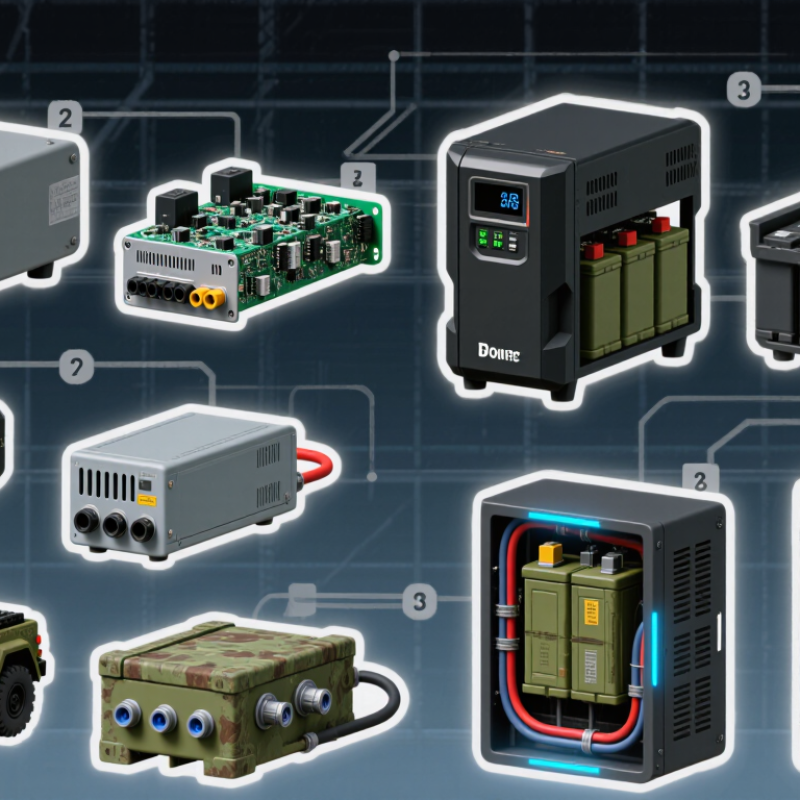
What Are the Top 10 Types of Military Power Supplies?

Defining Military Power Supplies by Mission, Platform, and Environment

What Are the Top 10 Types of Military Power Supplies?

Defining Military Power Supplies by Mission, Platform, and Environment

Military power supplies are best classified by mission, platform, and operating environment. The leading ten types include avionics power supplies, vehicle power converters, naval power units, soldier-worn supplies, radar supplies, communication supplies, unmanned-system supplies, space-rated supplies, rugged portable units, and medical equipment supplies. Each type solves a different power problem.

Avionics units support aircraft electronics under strict weight and vibration limits. Vehicle converters handle unstable battery inputs, heat, dust, and engine noise. Naval supplies resist salt spray and moisture. Soldier-worn units must remain light and quiet. Radar and communication supplies demand stable output during continuous operation. Unmanned systems prioritize efficiency and compact cooling. Space-rated supplies face radiation and extreme temperature changes. Portable and medical units require fast deployment, backup operation, and clear fault protection.

Mission demands should guide the design more than a product label. Engineers normally test voltage tolerance, electromagnetic compatibility, shock, vibration, humidity, and thermal cycling. They also inspect connectors and service access because small failures can stop a complete platform. A supply for a desert vehicle may need forced cooling, while a sealed naval unit may need better corrosion control. Perfect rankings are difficult. Platform requirements often overlap. A field technician may value repair access more than peak efficiency, although early specifications frequently overlook this detail. Reliable selection depends on measured data, mission records, and independent qualification testing.

Portable Battery Systems for Soldiers and Field Electronics

What Are the Top 10 Types of Military Power Supplies?

Portable power shapes every field decision. Soldiers may carry disposable primary batteries, rechargeable lithium-ion packs, lithium-iron-phosphate packs, wearable battery systems, manpack batteries, vehicle auxiliary batteries, solar chargers, fuel-cell generators, supercapacitor hybrids, and smart battery systems. Each type supports different missions.

A patrol team needs low weight and quiet operation. A command shelter needs sustained output, charging control, and safe thermal behavior. Battery systems should support radios, night-vision devices, tablets, sensors, and medical electronics. Practical designs also include waterproof connectors, glove-friendly controls, state-of-charge displays, and replaceable modules. MIL-STD-810H testing addresses vibration, shock, humidity, dust, and temperature. These details matter when equipment rests in wet soil or inside a hot vehicle.

The U.S. Department of Energy’s Advanced Batteries Liftoff Report projects global battery demand could reach about 4.7 terawatt-hours by 2030. Its analysis highlights energy density, safety, manufacturing capacity, and supply resilience. The Battery500 Consortium set a 500 Wh/kg research target, but field-ready systems still face compromises. Higher energy density may increase thermal-management demands. Lithium-iron-phosphate chemistry can improve safety, yet it may add weight. Fuel cells offer long endurance, though logistics become more complicated. A perfect portable supply does not exist. That assumption is worth challenging. Experienced operators should test recharge time, cold-weather performance, connector durability, and real mission loads, not only laboratory ratings.

Top 10 Types of Military Power Supplies

Representative specific energy values for battery chemistries commonly considered for portable soldier systems and field electronics. Values are practical technology ranges, and actual pack performance varies with enclosure weight, battery-management electronics, temperature, discharge rate, and mission requirements.

Vehicle-Based Power Units for Ground Combat Platforms

What Are the Top 10 Types of Military Power Supplies?

Vehicle-Based Power Units for Ground Combat Platforms

Ground combat platforms need steady power during movement, surveillance, communication, and field maintenance. The ten most useful types include engine-driven alternators, auxiliary power units, battery packs, DC-DC converters, AC inverters, power distribution units, hybrid power systems, regenerative braking units, fuel-cell generators, and shore-power interfaces. Each type serves a different electrical load. Alternators support continuous operation. Batteries provide quiet energy during short missions. Converters protect sensitive electronics from unstable voltage. Inverters supply controlled alternating current for specialist equipment.

Vehicle size and mission profile determine the best combination. A tracked platform may require rugged alternators with vibration-resistant mounts. A reconnaissance vehicle may benefit from silent battery operation during stationary observation. Hybrid systems can reduce engine runtime, heat, and fuel use. However, their control software adds complexity. That trade-off deserves serious testing. Small mistakes in load planning can overheat cables or drain reserve batteries quickly.

Reliable vehicle power units require sealed connectors, thermal monitoring, circuit isolation, and accessible service points. Engineers should test them through dust, moisture, shock, cold starts, and repeated voltage changes. Redundancy matters. One failed module should not disable every essential function. Maintenance crews also need clear fault codes and practical replacement procedures. Real-world repairs rarely happen in perfect workshops. Some assumptions may fail under harsh terrain or unexpected electrical demand. Careful logging and post-mission inspection help reveal those weaknesses.

Aircraft and Naval Power Supplies for High-Demand Operations

What Are the Top 10 Types of Military Power Supplies?

Aircraft and naval platforms face demanding electrical conditions. Their power supplies must handle vibration, salt spray, temperature changes, and sudden load shifts. Common types include AC-DC converters, DC-DC converters, inverters, rectifiers, battery chargers, uninterruptible power supplies, frequency converters, avionics power supplies, radar power units, and propulsion power supplies.

Aircraft often rely on compact 28-volt DC systems or controlled AC power. A reliable converter keeps navigation, communication, and flight-control equipment stable during engine transitions. Avionics supplies need low electrical noise and fast protection against voltage spikes. Inverters support equipment that requires regulated AC power. Battery chargers must manage heat carefully, especially inside crowded equipment bays.

Naval power systems demand greater resilience. Salt air can damage connectors, while vibration can loosen weak assemblies. Rectifiers and DC-DC converters support sensors, communications equipment, and control cabinets. High-power radar units may require specialized supplies with strict insulation and cooling controls. Propulsion-related supplies must tolerate heavy starting currents without disturbing critical loads.

Testing should include cold starts, shock, humidity, and repeated power cycling. Field experience shows that laboratory success does not guarantee shipboard reliability. A connector may pass inspection yet fail after months near seawater. No design is perfect. Engineers should leave service access, monitor real operating data, and review failures honestly. That discipline often improves the next power system.

Specialized Power Sources for Tactical and Extreme Conditions

Specialized Power Sources for Tactical and Extreme Conditions

The top ten military power supplies serve different field problems. They include primary lithium cells, rechargeable lithium-ion packs, lithium-iron-phosphate batteries, thermal batteries, fuel cells, solar blankets, hand-crank generators, vehicle DC systems, portable generators, and supercapacitors. Primary lithium cells offer long storage life and strong cold-weather performance. Rechargeable packs reduce resupply needs, but heat, damage, and charging discipline remain serious concerns.

The International Energy Agency reported global battery demand above 750 GWh in 2023. That figure shows manufacturing scale, not battlefield reliability. Military users still need sealed cases, low electromagnetic signatures, and rapid replacement.

MIL-STD-810H evaluates equipment against temperature, vibration, shock, rain, humidity, altitude, sand, and dust. Thermal batteries can activate quickly during short missions. Fuel cells provide quiet endurance, while solar blankets support observation posts when sunlight is available. Clouds remain a stubborn weakness.

Field technicians often combine sources instead of trusting one device. A vehicle DC converter can charge lithium packs. A supercapacitor can handle sudden loads. A generator can provide sustained output, though its noise and fuel burden expose a position.

The U.S. Department of Energy reports typical fuel-cell electrical efficiencies near 40–60 percent, depending on design and operating conditions. Real deployments are less tidy.

Cables freeze, connectors fail, and batteries lose capacity. Engineers should test every power chain with gloves, dust, darkness, and limited tools. Perfect specifications rarely survive those conditions.

FAQS

What are the main power supplies used in aircraft and naval platforms?

Common types include converters, inverters, rectifiers, chargers, frequency converters, and uninterruptible supplies. Radar and propulsion systems need specialized power units.

Why are aircraft power supplies especially demanding?

Aircraft systems face vibration, temperature changes, engine transitions, and sudden load shifts. Compact 28-volt systems need stable conversion.

How do avionics power supplies protect sensitive equipment?

They reduce electrical noise and respond quickly to voltage spikes. Stable output helps navigation, communication, and flight-control equipment operate reliably.

What challenges affect naval power systems?

Salt air can corrode connectors, while vibration can loosen weak assemblies. Cooling and insulation become critical around high-power radar equipment.

Which portable power sources support difficult field conditions?

Options include lithium cells, rechargeable battery packs, fuel cells, solar blankets, portable generators, and supercapacitors. Each source has limits.

How should rechargeable battery packs be managed?

Operators should control heat, prevent damage, and follow disciplined charging practices. Capacity can fall sharply in cold conditions.

Can one power source support every mission?

Usually not. Technicians often combine vehicle converters, batteries, generators, and supercapacitors for different loads.

What testing helps reveal real-world power problems?

Testing should include cold starts, shock, humidity, dust, darkness, and repeated power cycling. Use gloves and limited tools.

Why can laboratory testing fail to predict field reliability?

A connector may pass inspection but fail after months near seawater. Laboratory success can mislead.

What design lessons improve future power systems?

Leave space for service access, monitor real operating data, and review failures honestly. No design is perfect. Clouds remain a weakness for solar power.

Conclusion

Military Power Supplies are designed to support a wide range of missions, platforms, and operating environments. The top types include portable battery systems, soldier-worn power packs, field charging units, vehicle-based power units, auxiliary power systems, aircraft power supplies, naval power systems, ruggedized generators, renewable-assisted tactical sources, and specialized power solutions for extreme conditions. Each type is developed to provide dependable electricity while meeting strict requirements for mobility, durability, safety, and efficient energy management.

Portable systems support communications, sensors, navigation equipment, and other field electronics used by personnel. Vehicle-based units deliver higher power for ground platforms and mission equipment, while aircraft and naval supplies are engineered for demanding operations where weight, vibration, moisture, and reliability are critical. Specialized sources may be adapted for cold, heat, dust, wet environments, or remote deployment. Together, these power solutions help maintain operational readiness by providing stable, protected, and adaptable energy across diverse military applications.

Ethan

Ethan

Ethan is a professional marketing specialist dedicated to helping businesses better understand, present, and apply innovative products and solutions. With a strong knowledge of the company’s product portfolio, market trends, customer needs, and industry developments, he creates clear, practical,......