Global demand for Electric Vehicle Power Supplies is expanding with the vehicle market. The International Energy Agency’s Global EV Outlook 2024 reported more than 17 million electric cars sold in 2024. Electric models represented about one in five new cars worldwide. This growth increases demand for onboard chargers, DC fast-charging modules, wall boxes, connectors, and power-conversion systems.
Sourcing these products globally is not simply a price exercise. Buyers must compare voltage ranges, charging protocols, thermal performance, ingress protection, efficiency, and service life. The U.S. Department of Energy’s Alternative Fuels Data Center highlights the importance of connector compatibility and charging-network requirements. Meanwhile, the EU’s AFIR framework is pushing greater consistency across public charging infrastructure. Regional differences remain significant. A supplier suitable for a 400-volt passenger vehicle may not support an 800-volt fleet platform.
Reliable procurement also depends on traceability. ISO 9001 systems, laboratory test reports, factory audits, and documented component origins provide useful evidence. BloombergNEF’s Electric Vehicle Outlook continues to identify battery costs, infrastructure investment, and supply-chain resilience as major industry factors. These issues directly affect sourcing decisions. A low quotation can hide longer lead times, weak technical support, or repeated certification work. That mistake is easy to make.
This guide examines supplier discovery, technical screening, compliance checks, logistics, and risk control. It also considers regional manufacturing strengths and after-sales capabilities. Data can change quickly, and published forecasts sometimes disagree. Procurement teams should verify every critical claim before signing a contract. The details matter.
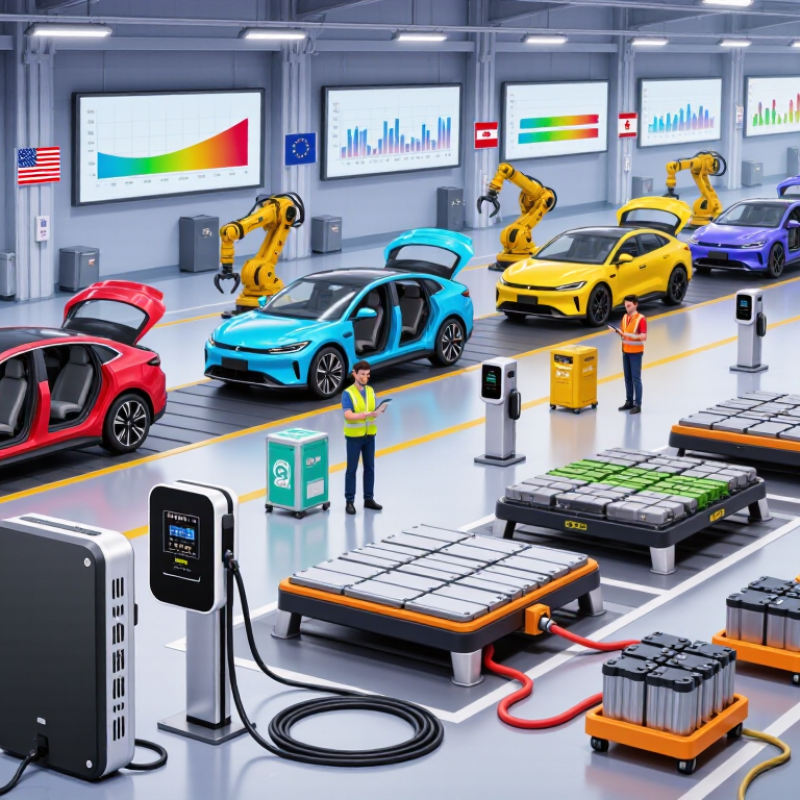
How to Source Electric Vehicle Power Supplies Globally?
Global sourcing begins with a precise definition of the electric vehicle power supply. Before contacting suppliers, record input voltage, frequency, output power, charging mode, connector type, and operating temperature. A depot in Singapore may need different grid compatibility than a workshop in Germany. Document the duty cycle, installation location, cable length, and expected daily charging hours. Small details matter. They affect cost, safety, and delivery schedules.
Map each requirement against applicable technical standards. IEC 61851 can guide conductive charging system design, while IEC 60364 supports electrical installation planning. ISO 15118 may apply when communication between the vehicle and charger is required. Check regional certification rules separately; international standards do not replace local approval. Request evidence for insulation resistance, dielectric strength, electromagnetic compatibility, grounding, thermal protection, and ingress protection. An outdoor cabinet may need verified resistance to rain, dust, and repeated temperature changes. Ask for test conditions, not only certificate numbers.
During supplier evaluation, review production samples and factory test records. Confirm power stability under low-voltage and high-load conditions. A pilot installation can reveal connector heating, software delays, or unclear fault indicators. I have seen technically strong units fail because their service documents were incomplete. That weakness deserves attention. Keep drawings, test reports, revision histories, and calibration records in one controlled file. Recheck every specification after the first sample, because assumptions often survive longer than errors.
Global sourcing starts with qualified suppliers, not the lowest quotation. The IEA’s Global EV Outlook 2024 reported nearly 14 million electric cars sold in 2023. China represented more than 60% of global sales, making East Asia a major production region for chargers, converters, and battery power units. Europe offers strong engineering depth and proximity to strict vehicle markets. North America provides mature compliance systems and regional manufacturing incentives.
Ask suppliers for audited production records, not attractive brochures. Verify ISO 9001 quality systems, ISO 14001 environmental controls, and IEC 61851 or IEC 62196 compatibility where relevant. Request thermal-cycle results, ingress-protection tests, electromagnetic-compatibility reports, and failure-rate data.
Inspect the factory floor if the order is strategic. A clean sample proves little. Production consistency matters more.
The IEA’s Global Critical Minerals Outlook 2024 highlights concentrated supply chains for several materials used in electrification. Therefore, evaluate copper, power semiconductors, magnets, and cable inputs beyond the final assembly country. Check dual-source options across Asia, Europe, and the Americas. Require lot traceability and documented change-control procedures. Delivery promises can fail during port congestion or component shortages. Plan buffer stock, but avoid excessive inventory. This balance remains difficult.
My own sourcing reviews often find capable factories with weak documentation, or excellent paperwork with unstable subcontractors. Supplier scoring should include technical evidence, financial resilience, regional risk, after-sales support, and transparent subcontracting. The cheapest offer is frequently incomplete.
How to Source Electric Vehicle Power Supplies Globally?
Global sourcing for electric vehicle power supplies begins with compliance, not a low quotation. Ask suppliers for current test reports, safety certificates, material declarations, and traceable production records. Confirm that each document matches the exact model, voltage range, connector, and destination market. A certificate for a similar unit is not enough. It creates risk.
Quality control should be visible on the factory floor. Review incoming component checks, soldering standards, insulation tests, thermal testing, and final load tests. Request sample units from different production batches. An independent inspection can verify dimensions, labels, packaging, and electrical performance before shipment. Small details matter. Loose terminals can become expensive field failures. Factory audits help, but they cannot replace regular batch inspections.
Pricing requires more than comparing unit costs. Include tooling, minimum order quantities, freight, duties, testing, warranty reserves, and currency changes. A cheaper quotation may hide longer lead times or weaker component controls. Production capacity also needs evidence. Check monthly output, active orders, critical component inventory, backup suppliers, and peak-season schedules. Ask for a realistic production plan, not a hopeful promise. No scorecard is perfect. I would revisit supplier ratings after every shipment, because one successful sample does not prove stable manufacturing.
| Source Region | Typical Product Scope | Key Compliance Frameworks | Typical Power Range | Indicative Unit Price (USD) | Typical MOQ | Typical Lead Time | Production Capacity Indicator | Recommended Quality-Control Measures | Compliance Readiness |
|---|---|---|---|---|---|---|---|---|---|
| East Asia | AC wall-mounted chargers, DC charging modules, portable EV power supplies, and high-volume OEM products | IEC 61851, IEC 62196, ISO 15118 where applicable, regional electrical safety and electromagnetic-compatibility requirements | AC: 3.6–22 kW DC: 20–180 kW |
AC: $180–$900 DC: $3,000–$35,000 |
50–500 units for standard models; higher for customized designs | 4–10 weeks after approval of specifications | Generally strong for high-volume production, automated assembly, and private-label customization | 100% functional testing, insulation-resistance testing, grounding verification, thermal testing, ingress-protection testing, and production-lot sampling | High |
| Southeast Asia | AC chargers, compact DC chargers, cable assemblies, and final assembly for regional export markets | IEC 61851, IEC 62196, local electrical regulations, and destination-market certification requirements | AC: 7–22 kW DC: 20–120 kW |
AC: $220–$1,000 DC: $4,000–$25,000 |
100–1,000 units | 6–12 weeks, depending on imported components and certification status | Moderate to strong capacity; often suitable for diversified sourcing and second-source programs | Incoming inspection for power modules, supplier traceability, burn-in testing, connector-cycle testing, and final electrical-safety testing | Medium–High |
| Europe | Premium AC chargers, commercial DC charging equipment, load-management systems, and grid-integrated solutions | IEC 61851, IEC 62196, CE-related requirements, EMC and low-voltage rules, RoHS, REACH, and local grid-connection rules | AC: 7–22 kW DC: 30–350 kW |
AC: $500–$1,500 DC: $15,000–$80,000 |
10–100 units for standard products; larger projects are normally contract-based | 8–20 weeks, especially for high-power systems | Strong engineering and compliance capability; capacity may be constrained for customized high-power systems | Factory acceptance testing, power-quality measurement, environmental testing, cybersecurity review for connected products, and documented component traceability | Very High |
| North America | Residential and commercial AC chargers, fleet chargers, and high-power DC charging systems | UL 2231, UL 2594, NEC installation requirements, FCC electromagnetic-compatibility requirements, and applicable local certification rules | AC: 7–19.2 kW DC: 50–350 kW |
AC: $450–$1,800 DC: $20,000–$100,000 |
10–100 units for catalog products; project orders vary by deployment size | 8–24 weeks, depending on certification and power rating | Strong for certified products; high-power equipment may require scheduled production slots | Certification-file review, dielectric-strength testing, ground-fault protection verification, thermal-rise testing, software validation, and site-acceptance testing | Very High |
| South Asia | Cost-sensitive AC chargers, fleet charging equipment, power-conversion assemblies, and regional-market products | IEC 61851, IEC 62196, applicable national standards, EMC requirements, and destination-market certification | AC: 3.3–22 kW DC: 15–120 kW |
AC: $200–$850 DC: $4,000–$24,000 |
100–1,000 units | 6–14 weeks | Growing capacity with good potential for cost reduction; component sourcing and validation require close monitoring | Supplier audits, first-article inspection, power-cycle testing, connector and cable inspection, software-version control, and accelerated life testing | Medium |
| Latin America | Imported AC chargers, commercial charging cabinets, replacement power modules, and locally integrated systems | IEC 61851, IEC 62196, national electrical codes, local certification requirements, and utility interconnection rules | AC: 7–22 kW DC: 20–180 kW |
AC: $300–$1,300 DC: $8,000–$40,000 |
10–100 units for imported products; local projects may require smaller batches | 10–24 weeks, including international logistics and customs clearance | Local manufacturing capacity varies; regional distributors and system integrators are often important for deployment | Pre-shipment inspection, documentation verification, voltage-frequency compatibility checks, spare-parts planning, and on-site commissioning tests | Medium |
Price ranges are indicative market estimates for 2025–2026 and may exclude freight, duties, installation, software subscriptions, certification fees, and site electrical upgrades. Final sourcing decisions should be based on a documented technical specification, third-party certification verification, factory audit, sample testing, and total landed cost.
Global sourcing of electric vehicle power supplies requires more than finding a competitive factory. The International Energy Agency reported nearly 14 million electric cars sold in 2023, creating urgent demand for chargers, converters, and power modules. That growth also increases customs pressure. A shipment may include cables, control boards, cooling parts, and lithium-containing components, each requiring accurate classification.
Documentation must match the physical cargo. Prepare a commercial invoice, packing list, certificate of origin, and correct HS codes before pickup. The importer of record should confirm duties, technical approvals, labeling rules, and local electrical requirements.
Battery-related items may also require safety declarations and transport documentation. Small errors compound. A wrong product description can delay a container for days.
The World Bank’s 2023 Logistics Performance Index shows uneven customs efficiency across markets. UNCTAD also reports that maritime shipping carries over 80% of global merchandise trade, so port delays can quickly affect project schedules. Use a forwarder experienced in electrical equipment, but do not outsource every decision. Check carton dimensions, serial numbers, declared values, and consignee details against the invoice. I have seen teams trust automated templates too much. They save time, but one outdated HS code can create expensive rework. Clear document ownership and a pre-shipment audit remain practical safeguards.
Global electric vehicle power supply sourcing needs more than a low unit price. A clear contract should define voltage ranges, power ratings, connector specifications, packaging, delivery terms, and acceptance criteria. It should also require batch traceability and advance notice for design changes. Payment milestones can link to inspection results, not only shipment dates. Keep the language practical.
Testing procedures should match real vehicle conditions. Each shipment can receive visual checks, insulation resistance tests, output-load tests, and temperature-rise measurements. Critical samples should undergo vibration, humidity, thermal cycling, and electromagnetic compatibility testing. Records need serial numbers, equipment calibration dates, operators, and failure images. Photographs help.
Do not rely on a supplier’s certificate alone.
Long-term plans should combine rolling forecasts with reserved production capacity. A twelve-month forecast may guide materials, while a shorter confirmed order controls manufacturing. Dual sourcing can reduce disruption, but it may also create inconsistent firmware or connector tolerances. This risk needs cross-source validation. Maintain a sensible safety stock near major delivery routes, especially during port congestion or seasonal demand changes. Review quality data quarterly, including defect rates, late shipments, field returns, and corrective-action speed. A spreadsheet forecast is never truth. Market demand changes faster than contracts. Leave room for controlled revisions, although excessive flexibility can weaken accountability. Clear escalation contacts and documented corrective deadlines make international cooperation more dependable.
Record input voltage, frequency, output power, charging mode, connector type, and operating temperature. A depot and workshop may need different grid compatibility. Details matter.
Request current safety certificates, test reports, material declarations, and traceable production records. Confirm each document matches the exact model and destination market. Similar documents are not enough.
Ask for insulation, dielectric strength, grounding, thermal protection, and electromagnetic compatibility results. Request test conditions, equipment details, and failure records. Certificate numbers alone provide limited confidence.
Review incoming component checks, soldering controls, insulation testing, thermal tests, and final load tests. Inspect samples from several production batches. Independent inspections can catch loose terminals, labeling errors, and weak packaging.
Include tooling, minimum order quantities, freight, duties, testing, warranty reserves, and currency changes. A low unit price may hide longer delivery times. Cheap is not always cheaper.
Check monthly output, current orders, critical component inventory, backup suppliers, and seasonal schedules. Ask for a realistic production plan. Hope is not evidence.
Specify voltage ranges, power ratings, connector dimensions, packaging, delivery terms, and acceptance criteria. Require batch traceability and advance notice of design changes. Payment milestones may depend on inspection results.
Use visual checks, insulation tests, output-load tests, and temperature-rise measurements. Critical samples may need vibration, humidity, thermal cycling, and electromagnetic testing. Keep serial numbers, calibration dates, operators, and failure photos.
Use rolling forecasts, reserved capacity, and sensible safety stock near major delivery routes. Dual sourcing can reduce disruption but may create firmware or connector differences. Cross-source validation remains necessary. Plans change. Recheck them.
Sourcing Electric Vehicle Power Supplies globally requires a structured approach that begins with clearly defining technical requirements, voltage and power specifications, safety expectations, communication functions, and applicable regional standards. Buyers should identify qualified international suppliers and suitable manufacturing regions by reviewing engineering capabilities, production experience, certifications, quality systems, and supply continuity. A thorough evaluation should also compare compliance, product testing, quality-control procedures, pricing, lead times, and available production capacity.
Successful international procurement depends on careful planning beyond supplier selection. Businesses should coordinate cross-border transportation, customs procedures, import documentation, packaging requirements, and delivery responsibilities before placing orders. Clear contracts should define specifications, inspection criteria, warranty terms, payment conditions, and procedures for handling nonconforming products. Establishing sample testing, pilot production, performance verification, and regular supplier reviews can reduce risk. Finally, a long-term supply plan should include demand forecasting, inventory strategies, technical updates, and continuous improvement to support reliable access to Electric Vehicle Power Supplies as market needs evolve.